There is a very specific kind of Saturday morning adrenaline. It hits around 6:45 AM, usually while you're holding a lukewarm mug of coffee, scrolling through a local estate sale listing with twenty blurry photos of basement junk, praying that one of them is hiding a piece of mid-century gold.
Most of the time, it’s not. Most Saturdays, you drive twenty minutes to a suburban split-level, stand in a line behind three professional antique dealers who look like they belong on a tactical SWAT team, and walk out with a chipped ceramic owl you didn't need.
But every once in a while, the stars align.
Last month, I hit a Saturday estate sale three miles from Princeton’s campus—the kind of house where a former art professor had lived since 1974, leaving behind a living room full of character, patina, and zero mass-market flat-pack furniture.
My budget for the entire room transformation was $50.
Here is the exact breakdown of what I bought, why I bought it, and how a forty-seven-dollar investment entirely changed my living room.
The Haul: What $47 Actually Buys
When you're shopping estate sales on a tight budget, you aren't looking for perfection. You're looking for good bones, solid materials, and soul.
Here is the receipt:
The Solid Walnut Side Table — $22
Why I bought it: It was buried under a pile of old National Geographics in the corner. The finish was scuffed, and it had a water ring the size of a teacup on top. But it was genuine solid walnut, with tapered mid-century legs and joints that didn't wiggle an inch. In today's retail market, a particle-board side table covered in laminate costs four times that.
The fix: Ten minutes with some fine-grit sandpaper and a dab of Howard Feed-N-Wax brought the wood grain roaring back to life.
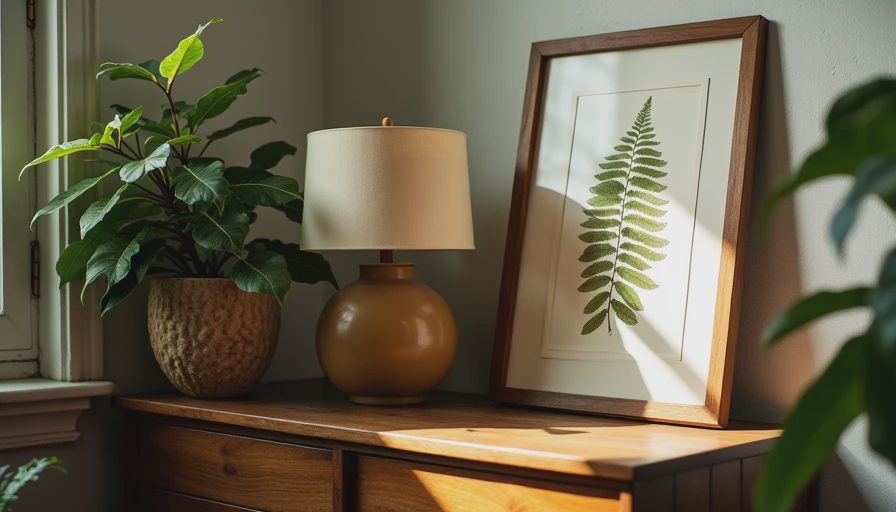
The Heavy Ceramic Table Lamp — $15
Why I bought it: Most cheap lamps look cheap because they lack weight. This one had a heavy, organic textured ceramic base in a muted, earthy ochre tone that instantly caught my eye. It didn't come with a harp or a shade, but the wiring was completely intact.
The fix: I paired it with a $12 linen-look drum shade from Target (the one splurge outside the estate sale) to soften the light.
The Framed Vintage Botanical Print — $10
Why I bought it: Mass-produced art often feels sterile because it's printed on slick, modern paper. This was an original 1960s book plate of wild ferns, preserved under glass in a simple, heavy wood frame with genuine patinated brass hardware. It gave instant depth and a sense of history to a blank rental wall.
Total Spent at the Sale: $47.00.
Why Buying Secondhand Changes How You Decorate
When you furnish an apartment entirely from big-box stores or fast-decor sites, your room ends up looking like a showroom floor. Everything matches, but nothing tells a story.
When you bring in vintage or thrifted pieces, you introduce texture and time. That walnut side table has dents from decades of someone else's life—and that’s a feature, not a flaw. It means you don't have to panic the first time your cat (or a guest) leaves a scratch or a spill on it. The room becomes a collection, not a catalog.
Annie's Rules for Estate Sale Success
If you want to score pieces like this without spending your whole Saturday driving around empty-handed, keep these three rules in mind:

Look past the clutter. Estate sales are chaotic by nature. People die, downsize, or move, and families cram items into rooms haphazardly. Train your eye to look at materials (solid wood, brass, heavy ceramics, natural linen) rather than the surface dust.
Inspect the structure, ignore the finish. Scratches, water rings, and outdated upholstery are easy fixes. A wobbly frame, structural water damage, or particle-board swelling are dealbreakers.
Trust your gut over trends. Don't buy something just because it's "vintage mid-century" if you hate the shape. Buy it because you can't stop thinking about the color, the texture, or the way it anchors a corner of your room.
Your home doesn't need a four-thousand-dollar styling budget to feel rich and layered. Sometimes, it just needs forty-seven dollars, an early Saturday morning, and an eye for what things can be.
"Start with what you love. The rest finds its place."