
Kitchen counter lamps can make a hardworking room feel softer and more welcoming, especially when the overhead lights are a little too eager. Choose a small, stable lamp with a washable or easily dusted shade, place it well away from the sink and stove, and use it for atmosphere rather than food prep. The nicest one is the one that leaves you enough room to make dinner.
Find the right lamp for your kitchen
Start with the spot, not the shopping cart. A quiet corner near an outlet, the far end of a counter, or a dry coffee station can all work. Look for a surface where the lamp won't compete with a cutting board, drip tray, or the everyday landing zone for groceries.
For a budget-friendly search, IKEA's table lamp range is a useful place to look for simple shapes and smaller footprints. Target's Threshold line is worth browsing if you like a more traditional, layered look. And a thrifted ceramic table lamp can be lovely for someone who wants a little color and character without a perfectly matched kitchen. Check the condition and electrical safety of any secondhand find before using it; a damaged cord or questionable wiring is a reason to pass or consult a qualified repair professional.
I like kitchen counter lamps with a bit of visual weight at the bottom: a ceramic base, for example, can feel grounded beside smooth tile and straight cabinet lines. But a visually substantial base still needs to be stable in real life. Gently check that it doesn't wobble, and measure its actual footprint before bringing it home.
A small lamp can look lost against a long stretch of backsplash, while a wide shade can make a narrow counter feel crowded. Use a piece of paper cut to the base dimensions as a stand-in, then hold a similarly sized bowl or box above it to estimate the shade. It's not glamorous, but neither is packing up a return.
Measure the space before choosing a shade
Most kitchen counters sit beneath cabinets, so height matters as much as width. Measure from the counter to the underside of the cabinet, then compare that with the lamp's complete assembled height, including any finial. Leave comfortable space above it and follow the manufacturer's clearance and bulb instructions; don't assume a shade can sit tucked against a cabinet.
Consider what happens around the lamp, too. Can a cabinet door open without hitting it? Is there room to wipe behind the base? Does the shade block an outlet you use every morning? Kitchen counter lamps should earn their space, not turn making toast into a small obstacle course.
Shade material changes both the look and the upkeep. An opaque metal shade directs more light downward and can usually be wiped clean according to its care instructions. A fabric shade gives a softer, more diffused glow, but it can collect dust and cooking residue. A glass shade offers another smooth surface, though it will show fingerprints. Whatever you choose, keep the lamp outside the cooking splash zone.
I'd also pay attention to the shade's color. Cream or warm white tends to look gentler next to wood, brass, and warmer paint colors; a crisp white can feel cleaner against cool tile. Neither is a rule. Bring the shade into the room and see how it looks with both the lamp on and off.
Make the glow useful, not harsh
Kitchen counter lamps are best as accent lighting: the cozy glow you leave on while chatting after dinner, not the light you rely on to chop an onion. Keep proper task lighting over work surfaces, whether that comes from under-cabinet fixtures, pendants, or another appropriate source.
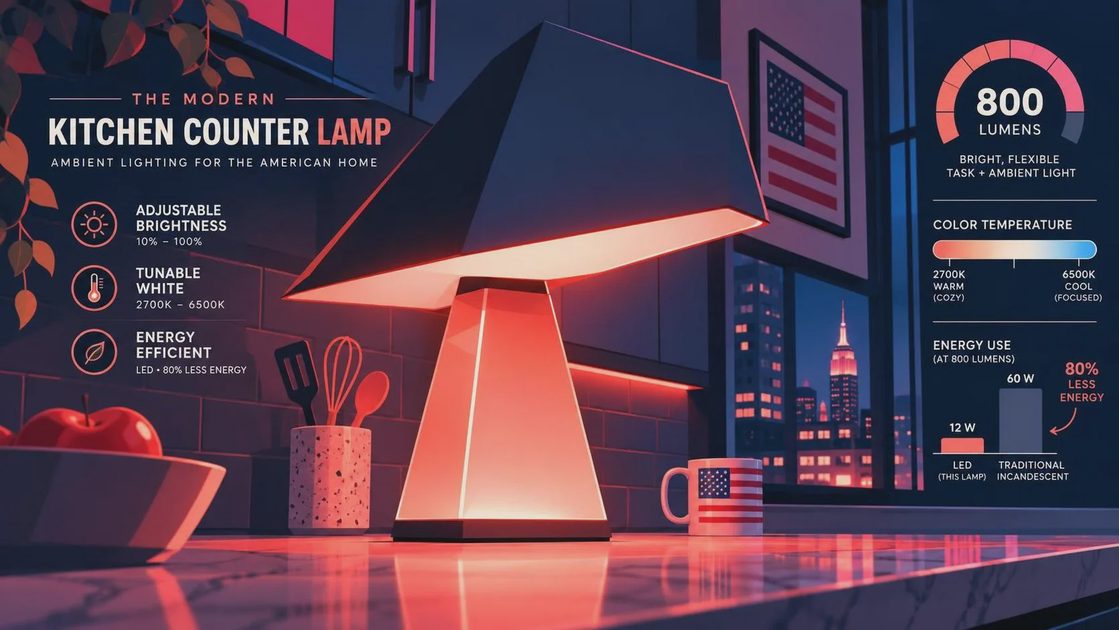
For a warm, relaxed look, start by considering an LED bulb labeled around 2700K. The number describes the bulb's color appearance, not its brightness; lower warm-white numbers generally look more golden. Check the lamp's bulb type and maximum rating, and make sure a dimmable bulb is paired with a compatible dimmer if you want adjustable light.
Brightness is listed in lumens. For a small accent lamp, choose a modest output and adjust to your room rather than assuming more light is always better. A shaded lamp near a pale backsplash may feel brighter than the same lamp beside a dark wall.

Place it safely around water and heat
A kitchen is still a kitchen, even when it looks charming at night. Keep an ordinary indoor table lamp away from the sink, faucet, stove, and other places where it could get wet, splashed, heated, or knocked over. Follow the lamp manufacturer's location and use instructions. If you can't find a dry, stable spot with a nearby suitable outlet, skip the plug-in lamp and consider lighting outside the work zone instead.
Route the cord so it doesn't cross a prep area, hang over the counter edge, or touch a hot surface. Avoid running it under a rug or squeezing it behind a hot appliance. Don't plug a lamp into an overloaded outlet or rely on an extension cord as a permanent solution. If the outlet location or protection raises questions, ask a qualified electrician.
Rechargeable kitchen counter lamps can be helpful where outlets are scarce, but cordless doesn't automatically mean water-safe. Check the manufacturer's instructions for placement and charging, and charge the lamp in a dry location. Also consider whether its light can be replaced or serviced and whether the switch is easy to reach under cabinets.
Style the corner without filling every inch
Give the lamp one or two companions, not an entire supporting cast. A small framed print propped against the backsplash and a utensil crock can provide different heights without swallowing the counter. Or let a colorful lamp stand alone against plain tile. Empty space is part of the arrangement, too.
For a connected look, repeat one color already in the room. A muted green base can pick up the green in a dish towel; a warm terracotta shade can echo a clay planter. The match doesn't have to be exact. Related tones feel more collected than a set of identical accessories.
Finally, live with the arrangement during an ordinary meal, not just when the counter is freshly cleared. If you keep shifting the lamp to make coffee or roll out dough, try another location. Kitchen counter lamps should make the room feel more like yours while leaving the kitchen free to do its job. Start with what you love. The rest finds its place.